Cead Mile Failte !

A 'hundred thousand welcomes' to friends of all things Irish, organic, and environmentally friendly. I hope you enjoy my anecdotes and little vignettes. I appreciate comments. If you like it, why not become a follower? Click on Archive and then scroll down to the very bottom for the beginning of our story. Or see: http://Ioncehadafarminireland.blogspot.com/
(©2010)

Sunday, November 21, 2010

Blackberry Wine


Wine from blackberries tastes best! This is a recipe from a good friend and expert winemaker. My own was left behind on the farm thinking I would never make wine again.
You need:
6 kg of fruit, a 25 l plastic bucket, 2 x 375 g sultanas
4 Campden tablets
2 sachets of Vinvik
4 spoons full of Pactolase (enzyme for making wine)
2-3 teabags of black tea
Demi Johns and sterilized wine bottles.
Pour fruit in a 25l plastic bucket. Crush fruit and slowly pour boiling water onto 6 kg of sugar until sugar has dissolved –this accelerates the fermentation process. Pour over fruit. Take 2 packets of sultanas (375g each), clean fruit and discard the water. Crush sultanas and add to fruit. Let 2-3 teabags steep in 1 cup of water. It adds tannin to wine. Fill up bucket with warm water until ¾ full. Dissolve 4 Campden tablets, available at homebrew stores. Add to mixture. It prevents wine turning into vinegar.
Cover well with muslin cloth and store in a warm place. Add wine yeast the next day. In Ireland, it was called Vinvik. You can take any other Bordeaux yeast but no beer yeast. 2 sachets suffice. Prepare according to instructions on sachets and add to fruit mixture. Add 4 table spoons of Pactolase. Stir every day if you find the time. Keep at warm temperature (25C). After a week or two, fill into Demi-Johns (gallon sized bottles with airlocks).
Remove Demi-Johns after 6-8 weeks, strain and fill into bottles. What you see in the picture below under "Homebrew" are a number of Demi-Johns bubbling away on kitchen table, making weird noises. Actually, you needn’t chop the fruit too finely. That way it just takes longer until wine is ready. If you don’t want to wait for you yummy wine, crush the fruit well.

Monday, November 8, 2010

Homebrew

Our local Whole Food Shop offers an organic beer and wine tasting and is making it a monthly recurring event. How times have changed!
Before we emigrated to Ireland, all we drank were organic wines due to the bad press conventional wines had received in Germany. The idea of having vineyards sprayed with pesticides from the air by planes put us off. Then an article in the London Times, Nov. 2001, confirmed my wildest fears about Chilean wines. Laborers in Chilean vineyards were suffering congenital neurological and respiratory defects in the second generation then due to the lavish, carefree application of pesticides and insecticides from the air.
In Ireland at the time, no organic wines were available, only came onto the market at horrendous prices years later. What is an organic farmer supposed to do if not make his own wine? We made strawberry, blackberry, elderberry and red currant wines in our kitchen the old fashioned way not using wine making kits that were available in the local homebrew store. Those and also organic cider.
The containers adorned the kitchen table and made interesting noises while fermenting away. Recipe to follow. Need to translate it first.

Tuesday, November 2, 2010

A Story about Baby Cut Carrots

Distracted as I am easily, I found this info worthwhile to include here.
From the Department of Life Education:

Baby Carrots:The following is information from a farmer who grows and packages carrots for IGA, METRO, LOBLAWS, etc.

The small cocktail (baby) carrots you buy in small plastic bags are made using the larger crooked or deformed carrots which are put through a machine which cuts and shapes them into cocktail carrots - most people probably know this already.
What you may not know and should know is the following:
Once the carrots are cut and shaped into cocktail carrots they are dipped in a solution of water and chlorine in order to preserve them (this is the same chlorine used in your pool).
Since they do not have their skin or natural protective covering, they give them a higher dose of chlorine.
You will notice that once you keep these carrots in your refrigerator for a few days, a white covering will form on the carrots. This is the chlorine which resurfaces. At what cost do we put our health at risk to have esthetically pleasing vegetables?
Chlorine is a very well-known carcinogen, which causes Cancer. I thought this was worth passing on. Pass it on to as many people as possible in hopes of informing them where these carrots come from and how they are processed.
I used to buy those baby carrots for vegetable dips. I know that I will never buy them again!!!!

Confirmed by Snopes in part. Could anybody help investigate if that is true for organic ones true? Since they wash organic eggs in chlorine solution I wouldn't put it past them!
In my next blog I'll yell you how we coped with an abundance of carrots on our organic farm.

Sunday, October 17, 2010

Yes, we can!


Our local grocery store how has a Green wise magazine and an online one called Go Green. 4 years I first started blogging under the title GOING GREEN. (One article:Superbowl Goes Green and The Full Flush:Toilets are Going Green ) I was the only one who brought reusable bags and got some looks!
Publix now recommends bringing a bag!What a change! My pharmacist there admits she is not as green as I must be -since I bring the bags.She has no idea of this blog. Must give her my card of this blog.
Guess what their tip # 3 is: Grow a compost heap! Yes, we can.It feels like going full circle.
Happy gardening!

Thursday, October 14, 2010

Gardener's Gold

You needn’t be an alchemist to turn your kitchen scraps into compost. Your healthy compost will be ready after several months depending on your location and prevailing weather conditions. Not only is it beneficial to the vegetables that you grow but it overall improves the quality of your soil. (In Europe we don’t call it dirt).
The best place to build your compost heap close is close to where you want to use it in the garden and close to your water source. Compost should resemble crumbly dark soil, smelling like earth. If it gets too wet, it gets slimy; a roof or tarp over it. A too dry pile is too compact for use. Don’t be shocked to find a wiggling worm on your hands.
In winter, before the new planting season starts, the compost needs to be dug into your existing soil. About 2 inches of this precious garden gold is advisable for soil improvement and better plant performance in the next season. It’s essential in order to simply replenish whatever nutrients have been taken out by growing your plants.
So get all these little critters to work for you. You’ll be surprised that a decent compost pile reaches about 66 degrees Celsius inside while the bacteria and worms are at work. For more information and troubleshooting, there is a Compost 101. Serious.

Wednesday, October 6, 2010

The long awaited COMPOST HEAP


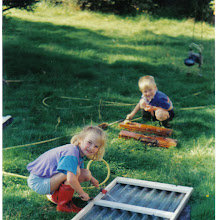
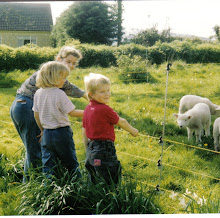
If you bother to grow your own vegetables- and here in Florida the new growing season is under way- you should spend time to make your own compost heap. This photo is the proof that a compost heap does not smell when done correctly : it was my son's and his friend's favorite spots to play at the age of 3. And we lived in a German village among neighbors who would not have tolerated anything untoward.
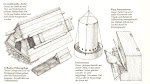
I'm trying to create one at the moment. You need a container, not the ones you can buy in certain wholesale place that don't have holes. Air needs do go thru it to ventilate. Just rolling the drum / plastic container, as suggested in that store, won't do it. As you can see from the picture a timber construction is easily made, you need a few planks on the ground and an enclosure. Not necessarily for climbing on top...Seymour in his ultimate Self-sufficiency book has different cheap solutions: an old oil drum with holes bored into it,the aforementioned wood structure or an even simpler one with chicken wire/mesh as sides to enclose the compost.You can build one with bricks on three sides and timber planks in the front or an old fashioned silo, depending on your needs.You never have enough good compost. That requires more space and maybe a little tractor or bobcat to handle once it grows. The easiest is if you can open it at the front, ie remove the timber planks and shovel the ripe compost, ie crumbly, healthy earth out that is full of nutrients and life.It's more important what goes in! You start with a layer of twigs, then almost anything that rots goes: leaves, grass clippings, left overs (which are not thrown into the garbage disposal. We fed them to dogs and pigs).Even newspapers, eggshells, bark, fish, avoid bones as the dogs will only dig them out anyway. They also take too long to be transformed into earth by all the microbes that will get to work instantly. In the process of composting, microorganisms break down organic matter and produce carbon dioxide, water, heat, and humus, the relatively stable organic end product. All of that should be alternated by layers of dirt and nitrogen containing material such as bone-meal or fish-meal. Algae or seaweed make an excellent starter, too. Not to forget tea leaves and coffee grounds- even with the filter. Worms love coffee! And then a layer of dung if you have it. You should water it from time to time if rain is lacking. Not a problem in Ireland. The perfect silo has a pointed top so that you can cover it in winter and the rain drops off- once it's ready.
It's ideal to have two heaps going at the same time. One that has matured and can be used and one that is still ripening.
How do you get the materials going and onto that heap? Collect them in a plastic container in the kitchen and carry out each day to throw on your developing heap. Seymour suggests to trample the heap each evening by foot or beat it with a spade...but there are certain limits and it worked just as well without doing that on a regular basis.

Friday, September 10, 2010

What 16 year-olds know about Farming & the AI man

In an earlier post I mentioned that a big percentage of Georgia( biggest grower of peaches in US) kids believe peaches grow in a tin. Here are some gems from a GED test. Are you ready?
Q. What is artificial insemination?
A. When the farmer does it to the bull instead of the cow

Q. How can you delay milk turning sour
A. Keep it in the cow

Q. What are steroids
A. Things for keeping carpets still on the stairs

Artificial Insemination, AI in short (and that is not artificial/alien intelligence), is done when the farm doesn't own a bull or the bull is not performing yet. Sometimes you also want to keep calving restricted to a certain time frame--and your vigorous bull is hard to keep away.
The AI man is usually a vet who arrives with cooling boxes in the trunk. Containers keep the sperm chilled until needed. The COWS have to be lined up in a one lane pen, ours was built out of timber, so that they go in one after another. Instead of opening the gates leading up to that paddock, he climbed them. Since you need two hands to climb a gate -when you are over 40 or so- he had to have his hands free. The syringe containing the bovine sperm went between his lips. He didn't talk until he reached the pen and took the syringe out ready to inseminate each cow standing behind them.They were separated from each other by a wooden barrier so that he wasn't kicked too often. He worked his way back to the line in no time. Another day's work done. In our second year we acquired Ismael who did the work for us. He was of a good-natured temperament, brown and very furry, not too big and had no horns. I was still in awe of him when passing through his field.

Wednesday, August 18, 2010

Greetings from Bavarian Mountains

From a trip to the Fatherland where the weather very much reminds me of many a summer in Ireland. Daily temperatures 11-15 C. Well, I wanted change from Florida's sweltering heat. But there is no such thing as bad weather--only wrong clothes.

Have been busy publishing my first book, hence the delay in new postings here. Also creating website with it and posting on related blogs. Info is all on the right under: What I like.
I hope some of you will like that too.
The book bears relevance to the Ex Farmer's Wife and what became of her...and how she ended up in FL.
Will be back telling about sheep shearing-if a bit late in the season for this year.

Monday, August 2, 2010

Ah, the joys of farming...


The current weather in Ireland reminds me of many a summer I spent there. In particular of 1987 when for 3 weeks in July it DID NOT rain for 2 afternoons. So now for you! I bought a padded coat, a Barbour hat and the central heating was running full blast. Hard to garden in those conditions. Pests thrive, veggies rot on the ground and fruit won't ripen. (See previous post about how we dealt with slugs).
My idea of putting the whole country under glass (meant as a joke) was met by stern looks by the Irish. My ex responded by building a huge glasshouse, ca.5x20m in the following months.Ah, the joys of farming in Ireland....
The pictures I spotted in Vogue Magazine are clothes that you definitely won't need on a farm, be that in Ireland or elsewhere. "Every garden-maker should be an artist along his own lines", said Vita Sackville-West.(Photo 1) They may be chic but utterly useless. I agree with their caption to photo 2: It's not easy being green. What you need are a Barbour jacket, raincoat and wellies.