Cead Mile Failte !

A 'hundred thousand welcomes' to friends of all things Irish, organic, and environmentally friendly. I hope you enjoy my anecdotes and little vignettes. I appreciate comments. If you like it, why not become a follower? Click on Archive and then scroll down to the very bottom for the beginning of our story. Or see: http://Ioncehadafarminireland.blogspot.com/
(©2010)

Monday, August 2, 2010

Ah, the joys of farming...


The current weather in Ireland reminds me of many a summer I spent there. In particular of 1987 when for 3 weeks in July it DID NOT rain for 2 afternoons. So now for you! I bought a padded coat, a Barbour hat and the central heating was running full blast. Hard to garden in those conditions. Pests thrive, veggies rot on the ground and fruit won't ripen. (See previous post about how we dealt with slugs).
My idea of putting the whole country under glass (meant as a joke) was met by stern looks by the Irish. My ex responded by building a huge glasshouse, ca.5x20m in the following months.Ah, the joys of farming in Ireland....
The pictures I spotted in Vogue Magazine are clothes that you definitely won't need on a farm, be that in Ireland or elsewhere. "Every garden-maker should be an artist along his own lines", said Vita Sackville-West.(Photo 1) They may be chic but utterly useless. I agree with their caption to photo 2: It's not easy being green. What you need are a Barbour jacket, raincoat and wellies.

Thursday, July 15, 2010

A wheelbarrow full of gherkins


Our local grocery store how has a Green wise magazine and an online one called Go Green. 4 years I first started blogging under the title GOING GREEN. (One article:Superbowl Goes Green and The Full Flush:Toilets are Going Green ) I was the only one who brought reusable bags and got some looks!
Publix now recommends bringing a bag!What a change! My pharmacist there admits she is not as green as I must be -since I bring the bags.She has no idea of this blog. Must give her my card of this blog.
Guess what their tip # 3 is: Grow a compost heap! Yes, we can.It feels like going full circle.
Happy gardening!

Monday, July 5, 2010

Green Germany vs. Emerald Isles : a culture shock

When we made the move to Ireland, organic farming, self-sufficiency and the whole shebang, we had years of green living and environmentally consciousness under our belts. Germany of the 80s had taken great strides in raising the public awareness. The Green Party was well established. As a German, I had been brought up with the motto “Waste not- want not”, that my grandparent’s. i.e., the war generation had drummed it in to us. It was natural to us to switch off any light upon leaving a room, or other unused gadgets, hang out the wash if the weather looked promising to save on electricity. In order to save on water and avoid surface pollution, German law forbids washing your car in the street. You must go to a car wash instead. The petrol crisis and the warnings of the club of Rome in the mid 70s had contributed to people saving gas whenever possible, downsizing cars, putting catalytic convertors in; cars were made fuel efficient. A debate was raging for years whether diesel or petrol was better for the environment. Another question was foremost on environmentalists’ minds: Does one save petrol by switching off the engine at a railroad crossing while waiting? Or at a red traffic light? In addition, being a bit of an activist –some said busybody - I would get out of my car in such a situation and ask the drivers before and behind me. “Does your engine have problems in starting, or are don’t you want to save the environment?” A speed limit was introduced in busy parts of Germany. The sky was no longer the limit as urban myth abroad about the Autobahn still claims.
A levy of 10 Pfennings on plastic bags had been introduced early on in the 80s if you went grocery shopping. So people made the switch and got accustomed to taking their own bags or baskets. We used rainwater for watering plants, off switched the tap while brushing our teeth and on again for rinsing. Water saving devices were installed into toilets, one for the small and one for the full flush. We avoided chemical cleaners around the house and substituted them with baking soda and vinegar. The use of aluminum foil and saran wrap as well as paper kitchen towels were reduced to a minimum. Freezers were defrosted regularly in order to reduce electricity. And then, after we had left for Ireland in 1990, recycling was taking to an all new level never seen before anywhere in the world. Until then, you kept paper and glass separate for recycling anyway, in addition, a bio- bin was introduced for scraps from the kitchen, and an extra bin for plastic or what is called “rest trash”. In some cities, households have 4 different trash cans. If you dare to mix the ingredients, maybe even by mistake, the bin men won’t pick it up.
Detergents were used so sparingly. Water softeners were the work of the devil since they hypertrophied rivers and lakes which make algae grow unnecessarily. There is no need for them if you hang your wash in the breeze, and definitely not if using a dryer.
When building our new house in Germany, it was built according to environmental standards with eco-friendly materials, in particular paints. In the renovating process of the Irish farm, Mac took gallons of Livos paint (eco!) on board in his hand luggage while I navigated 2 toddlers and their nappy bags in a stroller. Patrick, my second born, wasn’t exposed to disposable nappies –no, we had linen diapers and self-knitted panties made out of home spun untreated sheep wool. I didn’t spin though, only knitted …and then kept washing. They made the naturally big baby enormous around the midriff!
At some stage I had taken to making my own soaps and shampoos but it never turned out well enough to be of reliable use.
Being well trained in so many different areas, Ireland came as culture shock. The so called Green Isle was anything but “green”. Hedgerows were littered with plastic bags. My neighbor kept burning their rubbish, even attempted at setting metal cans on fire, exchanged their oil in the yard and let it drip down on the ground. I was the only one in the local store who bothered to bring a basket. Everybody else, even for buying just one bag of chips, got a plastic bag to wrap his purchase. In answer to the shop owner’s question why I did this since they had plastic bags…I told her about the German levy on bags. She frowned and said condescendingly, “That wouldn’t go down well in this country”. It took about 15 more years until Ireland had to face the music, too, as part of EU regulations, I suppose.
There was practically no awareness as to what was harmful to the environment, organic and eco products were not available. Clothes were way cheaper than in Germany but often made of poor quality, i.e. synthetics and not degradable. None of towns around Lough Dergh had a single water treatment plant until 1995. All household waste and sewerage plus farm effluents went untreated straight into the lake. So did the waste from numerous boats cruising on the lake, a tourist gem and the River Shannon.
Encountering this challenge in my newly adopted country made me bite my teeth on an ongoing basis. I was fit to be tied facing this sea of backwardness and having the ambition to change things for the better. I tried for many years. It’s hard work to convert a whole country.
Now here in the USA, I’m facing an even bigger challenge. Not just because of the size of the country, but because the irrefutable knowledge is there and widely available. The inertia that surrounds me seems to be unsurpassed, however. Apologies to states like WA , OR and CA where things are different.

Friday, July 2, 2010

Irish organic guidelines on washing eggs

Here is the IOFGA official answer to my request to outline whether eggs are being washed in a chlorine solution as is customary here in the US:
Any of the egg packing plants I've ever inspected don't wash the eggs at all, it's not standard practice as far as I'm aware, although I'm not sure what they do at farm level. Where water is chlorinated for any kind of washing, the chlorine level would be much lower, generally max 2 ppm. Sometimes chlorinated water is used for washing saladleaves and it's usually 0.5 to 2 ppm. Depending on the size of the
factory, concentrated sodium hypochlorite is dosed automatically into the required water supply or else chlorine tablets are used with a certain number of tablets in a certain amount of water to give the required dosage.
Hope this is of some help,
Thanks,
Maeve
----- Original Message -----
From: IOFGA@Eircom.Net

Different countries different guidelines.

Sunday, June 20, 2010

Never say never....

My last blog was barely posted (Never again will I ....)when a friend gave me a basket of little peaches from her garden.You can't let anything go to waste is still written on my brain matter, so I spent Saturday night making peach preserve.Yum! With a drop of rum. Grand Marnier was always good for strawberries, and Slivovic for black-berries.
Another thing I thought I had left behind years ago:scraping a tree from lichen. Then it was in our Irish orchard and I was 7 month pregnant. Maybe you remember that story? Today I scraped an oak tree. I did it in my bikini in front of my house this Sunday morning in 90 F heat. Didn't have the right triangular scraper but wielded a long spade-like sharp blade.
On a more serious note, something else I haven't done in 14 years: clean organic eggs fresh from the hen. They are not as clean as you may think judging from what you can buy as organic in the store. They have small amounts of crap on them in spite of exchanging the straw they live, lie and lay on it. Unavoidable. However, by the time they make it to the shops they must have been washed somehow.
And herein lies the crux. An article last week by Dr. Merola brought threw me into action. He claimed grocery store organic eggs are being washed in a chlorine solution, waxed- sometimes by petroleum jelly and candled.I investigated...and they are. At least here in the USA, this is regulated by law, organic that is. Here is the link to the full unsavory, totally disconcerting story:http://www.americanchronicle.com/articles/view/163360
I spoke to the woman farmer at yesterday's market about the cleaning of eggs in chlorine. She knew about that procedure and pointed out that cancer patients come to buy her healthy untreated products. She had goats milk and cheese, too.
So back at home, I bit my tongue, cleaned the crap off before putting the eggs into the fridge. I've done worse. More of that some other time.

Wednesday, June 16, 2010

Elderflowers in Bloom

Elderflowers are in full bloom here. I guess in Ireland too? Whenever and wherever I see them -since I left the farm- a big sigh of relief escapes me; accompanied by a sense of freedom: "These days are long over, never do I have to make elderflower champagne and elderberry jam again,ever!" Or any other jam or any other wine for that matter, if I chose not to. Maybe you don't know the sensation of feeling obliged to make use of what is given to you for free,i.e. here by Mother Nature. Berries in abundance along hedgerows compelled me for almost 10 years to avail of the bounty that was given to me. In the end, there was always a huge supply of preserves etc. in the larder. But to get there...the work can't be underestimated.

Tuesday, June 15, 2010

Raising geese into Christmas dinners

We were lucky that first year and had 7 eggs. The most our couple ever produced was 9 and one unfortunately died that year. They are bigger than chicken eggs. Either Mother Goose or Father Goose will take turns and watch and sit on them until they hatch. During that period the parents, understandably, were most aggressive. We never let the kids go into that patch and feed them then. Trying to lock the sentinel parent into the hut at night was more difficult than ushering in the 2 together. He or she would chase the dog and you all around the hut and grassy patch until they eventually relented. Or we got lucky.
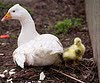
The average time for a goose egg to hatch is about 30 days. During that time, the parents do alternating shifts keeping the eggs warm. Little goslings are cute, yellow fluffy balls like chickens. After about a month they start to pin out, i.e. their pin feathers are growing. These are feathers that are shafted almost to the end, with a just a bit of fluff at the ends. Their tails look like feather dusters. Fast forward another month and you can hardly differentiate them from their parents. I lost my fear of them. Always wearing wellies and taking your dog helps. I didn’t particularly like having them in my orchard where also the washing line was situated. Why? They are messy creatures. And by that I mean: very messy. Impossible to go in there in your normal shoes. Being very environmentally conscious, I only used the tumble drier when the inclement Irish weather left me no other choice in the winter. Laundry that is flapping in the damp garden for more than 3 days and constantly rained upon is a nuisance and not very clean by the time you take it to the closest. Particularly when the lambs also roam that patch; for them it becomes a toy. It is also a nuisance to scamper for your wellies at the first sign of rain, run down the garden, open the gate and make your way through whatever animals are in pasture and collect your linen. After the second year, I put my foot down and insisted I would mow the grass and do without these free mowing helpers. Mac had suffered a childhood trauma having to mow their little city lawn and was reluctant to do it. Hooray, I eventually got an electric lawn mower and trimmer for my birthday. I was really grateful for that thoughtful present. A battle had been won.

Never sit a gosling in a big bath tub. While they enjoy the experience on a hot day, they will get tired and drown.
Preparing the geese for Christmas dinner,ie killing and plucking them is another story.

Sunday, June 6, 2010

Goosey, Goosey, Gander

Germans love their goose for Christmas. So it was only natural for us to enlarge our zoo by a pair of these big birds. We once had kept geese before in Germany while living in a cottage in the countryside. When they were ready around St. Martin’s Day for the roasting pot, I took them in our Toyota Landcruiser to a place where they were killed humanely. The method of one of our neighbors was to grab them by the neck and put them in front of a chainsaw. We still owned the same Toyota which is padded in the back area with carpet. What eejit of a car designer puts a fitted carpet into the area where you are likely to transport stuff and not have it lined by plastic sheeting or metal container that can easily hosed down? Anyway, I didn’t want to relive the experience. The card board box I had put them in then was soaked through in no time by their constant flow of smelly green excrements. Maybe they were nervous too and knew what was coming?
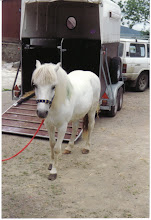
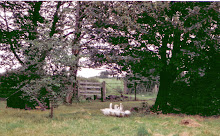
We found a pair of geese for sale in the Nenagh Guardian that often advertises agricultural goods, hay, or animals. We set out to pick them up somewhere near Terryglass, on the other side of Lough Derg, a mere hour away. Our preferred means of transport for them was our big horse trailer, the envy of all our neighbors. The geese were a mature couple that had hatched goslings before, we were assured. The drive home must have been like a rollercoaster for them. We had put some straw in for them to sit on, but a horsebox that is big enough for 2 grown horses proved to be a big merry-go-round for them. On each bend in the curvy country road they slithered all over the place. When we arrived home, they must have been so relieved to be shown to their new abode, a hut similar to what we had built for our broilers. A slanted roof structure made of Creosote-doused timber to withstand the Irish weather all year round. We put them in a field nearest to the back of the kitchen that was fenced partially and had wall and gate for easy access from the yard. Hoping for some goslings the same year, they would keep the weeds and grass low in that patch of yard. Later we alternated them with the sheep in our proper garden and orchard which was also surrounded by a strong fence.
Geese take a bit of getting used to. They are not very sociable and make hell of a noise if someone approaches them. Remember the story of them saving Rome with their noise from assaulting marauders? They also try to bite you or at least nip you when you go near them, especially when they have eggs to guard. Then they can get outright aggressive. Mac was bitten through his jeans several times over the years.
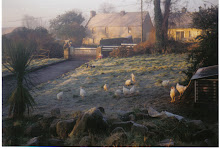
We let them out in the morning and ushered them back in at night before a fox could get to them. When you open the door in the morning, you want to step behind the door and have it between you and the geese who will scamper out immediately , ready for some foraging in the grass. At night, it’s a different story. More often than not they didn’t agree with what we considered bedtime. Just like our kids. Luckily Brandy, our fist dog, had turned out to be useful at herding up animals. She had to overcome her initial fear of geese which was proven justified often enough. Brandy was faster than the geese however, and that often saved her hind legs and butt. In order to put the geese to bed, both an adult and Brandy had to use all their tricks to drive them into the hut. We would stand behind the door ready to pounce and Brandy would chase them and direct them in. Depending on the weather or their mood, it could take several circling trips when they overshot the target before heading for their nice bed of straw for the night.

Tuesday, June 1, 2010

It'll be nice when it's all done....

We had loads of visitors in the first few years. Friends who wanted to see Ireland and even my doctor who wanted to check up on us. We gave them a warm welcome, took them on sightseeing trips which became boring after a while. How many times do you want to visit Bunratty Castle? For the first bunch I had even whitewashed the outbuildings on the yard. I had unpacked tons of removal crates to get the house into respectable order while working in the garden and cooking, making jams and baking breads and cakes. This couple, admittedly well-heeled, showed up in their blue suede Gucci loafers, looked around, and she said to me, “How can you bear it and not be running away screaming?” After one night, she deplored the lack of water pressure in the shower for her thick hair. “We should have stayed at Ashford Castle.” Needless to say, that friendship didn’t last much longer.
We, the blow-ins, were often asked by the natives,” Are you happy?” While Mac wholeheartedly answered in the affirmative, I hummed and hawed a bit, “Well, it’ s very nice here.” In a consoling tone, people remarked, “ It’ll be nice when it’s all done.”
And that became my leitmotif for the next few years while on the farm.