Sunday, January 23, 2011
The good old AGA
The old farmhouse had a coal (anthracite) fired hearth called AGA, the Rolls Royce under the ranges in the British Isles. Our model was a 4 door oven in light beige, with the hottest oven top right, the next hot bottom right, the coolest top left and bottom left somewhere in between temperature-wise. On top sat an iron range with two big rings. On the left ring, I would do my cooking and frying and then shove the pan to the right ring that offered a little less heat.It probably dated back to the 30s whereas the house itself had been built around 1890.The AGA had to be refilled with coals twice a day,first thing you got up and last thing at night. For that you had to lift the left ring on the surface and pour the coal in. Also did one have to empty the ashes first thing, i.e. before breakfast and then again late at night. The middle door at the bottom opens up for that. With a poker you rattle in the bowels of the AGA and the ashes start falling out. A dusty affair, too.Letting it go out ensued in a major cleaning and relighting operation that you didn't wish on anyone. Going away overnight was not on, even a late night at a party was dodgy or you would risk a lot of cold ashes. The coals were store across the yard in one of the sheds and had to be carried over once a day. The ashes were emptied behind the boiler room, a mere ten feet outside from the door. Later they would be used for composting or thrown on muddy paths and farm tracks that were notoriously squishy wet to soak up the water in the soil, i.e. for paving purposes.In my previous life, I had only been used to an electric range. It took a while to get used to it because it was much slower in getting things to the boil and would also burn more easily because the temperature was not adjustable. The previous owner used to simmer his porridge in the slowest oven over night (top left).It also came in handy to keep little premature and sickly lambs cozy and warm in a cardboard box over night on top of the stove. Again on the left as much as you could corner it or they would roast. When we did it the first time, I was afraid they might jump out of the box over night and fall onto the kitchen floor. They didn't, but usually looked perkier in the morning. The AGA was the centerpiece of the kitchen which also gave a lot of warmth. In fact, before we installed a central heating system into the old house, the previous owners had only relied on the AGA's efficiency , also for heating up the water and their bathroom. But that was done from another smaller one situated in the dining room which became part of our extended kitchen when we knocked the diving wall. I adorned it cottage-style with copper pans, lace and dried flowers. A sight to behold if it hadn't been for the soot that it also produced on a daily basis. Not ideal for the household members who suffered from asthma.

Monday, January 10, 2011
The Land is asleep but not the Farmer
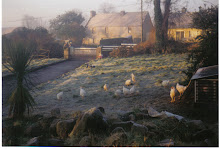
Life on the farm is relatively quiet at the beginning of the new year. Animals still have to be fed and watered but there is a calm before the lambing and calving season gets under way and land has to be plowed. Now is the time to fix fences and do repair jobs around the farm - and the house if there is time left. Also time for planning what to plant, which seeds to sow shortly when the sun feels a little warmer and "there is a stretch in the evenings", as Pauline would say. You can feel the evenings get that little bit longer by the end of January in spite of cold weather. The first snowdrops may show at the bottom of the orchard, followed by some crocuses, and a month later by early daffodils. This is my favorite time of the year with hope of a new growing season in the air - even if everything may still be frozen and blown to smithereens well into April.Our neighbors were having their first early lambs in the cold and dark of mid winter. A joy to see them frolicking in the fields but a lot of hard work to make them survive. Mac decided he would wait till later into spring so that the lambs had an easier start. You have to check on pregnant ewes at night, especially on first timers who had no more idea of what they were doing than we had.
Thursday, December 30, 2010
Ringing in the New Year
New Year’s Eve in Germany normally is a noisy affair since people set off fireworks everywhere. That was not the case in Ireland, neither on the farm nor in our village. Fireworks were and still are illegal in Ireland unless you have a license- e.g. for a public, official display.Living in the countryside, the most light we would see on a clear night were the stars—unless cloud coverage left us in the dark. City lights never offer such a spectacular view above your head.
After a long day of work around the yard and tending to the animals, a farmer wants an early night. Days have the tendency to be of a similar structure and work schedule because of the critters you take care of. Being early birds and having two small children, our night life suffered. The only sound on New Year’s Eve that I heard while lying awake and thinking of what life in Germany would be like was the ringing of the bells of the Killaloe Cathedral. Our trusted housekeeper had earned the privilege of ringing in the New Year. For her it was the highlight of the season. Mac, already asleep, would be disturbed by the sound of the bells and mumble something like: ”Can’t they keep it down a bit? I want to sleep.”
Happy New Year, everyone, noisy or otherwise…
After a long day of work around the yard and tending to the animals, a farmer wants an early night. Days have the tendency to be of a similar structure and work schedule because of the critters you take care of. Being early birds and having two small children, our night life suffered. The only sound on New Year’s Eve that I heard while lying awake and thinking of what life in Germany would be like was the ringing of the bells of the Killaloe Cathedral. Our trusted housekeeper had earned the privilege of ringing in the New Year. For her it was the highlight of the season. Mac, already asleep, would be disturbed by the sound of the bells and mumble something like: ”Can’t they keep it down a bit? I want to sleep.”
Happy New Year, everyone, noisy or otherwise…
Monday, December 20, 2010
Plucking the Xmas Dinner
In previous postings I told you about the parent pair of geese we acquired in our first year to provide us with Christmas roasts for years to come. The first was slaughtered for St. Martin's day, a tradition in Germany. In the weeks leading up to Christmas, word spread in the village and at the farmer's market in the parochial hall, that we had geese for sale - if only 4. Though not a traditional Irish Christmas dish, there were more people interested in getting these rare birds than we could provide.
What you need: a goose, buckets of scorching but not boiling water to dip the goose in head down and some stamina, ie not too delicate a nose. I had practiced before in Germany on our annual birds. But to do 4 was a a challenge. Each takes at least 90 minutes to pluck.
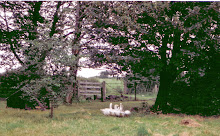
So my trusted helper and housekeeper put the kettle on to bring the water to a high temperature, on an AGA that can take an hour, while Mac and I chose and caught the poor first victim straight from the goose hut. Lifting the roof of the hut carefully, Father Goose became extremely aggressive, hissing and nipping at Mac's hands and jeans-clad legs. Their nips hurt! You have to grab the goose by its neck which pretty much renders it defenseless. On the yard, near the compost heap on the wall, we had a timber block for splitting kindling. Mac carried the goose over there speaking in soothing tones to it and caressing it with his second hand. He then put it on the block, I held its neck and Mac grabbed the axe. I didn't really dare to watch but necessity made me blink and double check that my arm was outstretched far away enough out of the danger zone.With one swift swing, the goose was in goose heaven. In contrast to chickens, you can't really wring their necks.They are too strong . But they don't flutter headless around the yard either. You have to let the blood drip out of the animal before you can proceed to plucking. Dip it into the hot water and the plucking can begin. We had a big double basin originating from a youth hostel so that my helper and I could stand comfortably over a basin and bucket with a goose each. Goose feathers are stubborn. Harder to pluck than chickens'. They were everywhere.Worst are the pin feathers. And geese do smell. Raised on a diet of pure grass, it's funny how much their intestines stink.After about an hour, your hands, legs, and feet have gone properly cold and numb, the feathers are done. At this stage, the chicken in me opted out due to a hypersensitive nose, and volunteered to put the kettle on for a tea brake. Pauline didn't mind. She finished the job cutting up the animals and pulling out the entrails, a very messy and malodorous job. Then she washed them many times with cold water and neatly presented them on a plate. Grateful, I had the tea and refreshments ready. Most times we had to remove little hairs that stubbornly stuck to the skin with tweezers without tearing the skin. After a while, Mac had the idea to use a little flame torch like restaurants use for making Creme Brule now, and just singe them off. Again, be careful not to burn or singe the skin. I think our reward was about 30 Irish Pounds per animal($70 today)of which I had to pay Pauline 10 for her work. Every year I toyed with the idea that we could collect the eiderdown and feathers to fill pillow cases. Somehow we never got round to it. The idea of washing these mountains of feathers was too much to undertake.Today I prefer to buy a goose, if I can find them organically grown. Thank goodness, my plucking days are over.
I was asked for a recipe: Stuffed with a mixture of bread, apples and onions, the bird requires slow roasting at 180C/375 F under continuous basting with water, its own juices, and occasional turning.2-3 hours as I recall. Delicious accompaniments are potatoes and red cabbage and apple sauce. Go for a lean bird; geese can be fatty.Ours never were because they were grass-fed, free-range--the sporty, muscular type.
Happy Holidays!
What you need: a goose, buckets of scorching but not boiling water to dip the goose in head down and some stamina, ie not too delicate a nose. I had practiced before in Germany on our annual birds. But to do 4 was a a challenge. Each takes at least 90 minutes to pluck.
So my trusted helper and housekeeper put the kettle on to bring the water to a high temperature, on an AGA that can take an hour, while Mac and I chose and caught the poor first victim straight from the goose hut. Lifting the roof of the hut carefully, Father Goose became extremely aggressive, hissing and nipping at Mac's hands and jeans-clad legs. Their nips hurt! You have to grab the goose by its neck which pretty much renders it defenseless. On the yard, near the compost heap on the wall, we had a timber block for splitting kindling. Mac carried the goose over there speaking in soothing tones to it and caressing it with his second hand. He then put it on the block, I held its neck and Mac grabbed the axe. I didn't really dare to watch but necessity made me blink and double check that my arm was outstretched far away enough out of the danger zone.With one swift swing, the goose was in goose heaven. In contrast to chickens, you can't really wring their necks.They are too strong . But they don't flutter headless around the yard either. You have to let the blood drip out of the animal before you can proceed to plucking. Dip it into the hot water and the plucking can begin. We had a big double basin originating from a youth hostel so that my helper and I could stand comfortably over a basin and bucket with a goose each. Goose feathers are stubborn. Harder to pluck than chickens'. They were everywhere.Worst are the pin feathers. And geese do smell. Raised on a diet of pure grass, it's funny how much their intestines stink.After about an hour, your hands, legs, and feet have gone properly cold and numb, the feathers are done. At this stage, the chicken in me opted out due to a hypersensitive nose, and volunteered to put the kettle on for a tea brake. Pauline didn't mind. She finished the job cutting up the animals and pulling out the entrails, a very messy and malodorous job. Then she washed them many times with cold water and neatly presented them on a plate. Grateful, I had the tea and refreshments ready. Most times we had to remove little hairs that stubbornly stuck to the skin with tweezers without tearing the skin. After a while, Mac had the idea to use a little flame torch like restaurants use for making Creme Brule now, and just singe them off. Again, be careful not to burn or singe the skin. I think our reward was about 30 Irish Pounds per animal($70 today)of which I had to pay Pauline 10 for her work. Every year I toyed with the idea that we could collect the eiderdown and feathers to fill pillow cases. Somehow we never got round to it. The idea of washing these mountains of feathers was too much to undertake.Today I prefer to buy a goose, if I can find them organically grown. Thank goodness, my plucking days are over.
I was asked for a recipe: Stuffed with a mixture of bread, apples and onions, the bird requires slow roasting at 180C/375 F under continuous basting with water, its own juices, and occasional turning.2-3 hours as I recall. Delicious accompaniments are potatoes and red cabbage and apple sauce. Go for a lean bird; geese can be fatty.Ours never were because they were grass-fed, free-range--the sporty, muscular type.
Happy Holidays!
Thursday, December 9, 2010
At the end of year one

Our first year was drawing to a close. Autumn storms that shook the buildings and the new slates that had been put on the piggery. "That'll put everything to the test" our handyman would say. We had found this gem, Martin, over the summer to give Mac a hand in doing up outbuildings and repairs in general. Farmer Mac had decided to go bigger next year and buy more sheep and cattle. Surprise, surprise he loved what he did, had gotten the hang of it and was ready to take our attempts at self-sufficiency to a higher level.
I had started teaching at the University of Limerick with the beginning of the Michaelmas term in September. Between baking, wine making, weeding, pickling, teaching, and driving kids to school I was occupied. No rest for the wicked-as they say.
Our first Christmas from home was going to be different. Real firs for Christmas trees were hard to come by. I usually made my own decorations over the mantelpiece, down the banister and various wheel size wreaths. For that I used evergreens like ilex, spruce or,twigs of an evergreen hedge plus ivy. What I missed most were German Christmas markets. But we would have the traditional goose for Christmas: one of our own.
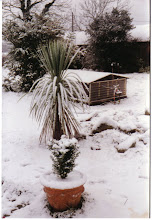
Being German we would celebrate Christmas eve instead of having Santa Claus come and bring the gifts in the early morning of dawn on Christmas day. So much more civilized I always find. At least the parents can sleep in. The new year surprised us with lots of snow. Like Ireland is seeing now.
Sunday, November 21, 2010
Blackberry Wine

Wine from blackberries tastes best! This is a recipe from a good friend and expert winemaker. My own was left behind on the farm thinking I would never make wine again.
You need:
6 kg of fruit, a 25 l plastic bucket, 2 x 375 g sultanas
4 Campden tablets
2 sachets of Vinvik
4 spoons full of Pactolase (enzyme for making wine)
2-3 teabags of black tea
Demi Johns and sterilized wine bottles.
Pour fruit in a 25l plastic bucket. Crush fruit and slowly pour boiling water onto 6 kg of sugar until sugar has dissolved –this accelerates the fermentation process. Pour over fruit. Take 2 packets of sultanas (375g each), clean fruit and discard the water. Crush sultanas and add to fruit. Let 2-3 teabags steep in 1 cup of water. It adds tannin to wine. Fill up bucket with warm water until ¾ full. Dissolve 4 Campden tablets, available at homebrew stores. Add to mixture. It prevents wine turning into vinegar.
Cover well with muslin cloth and store in a warm place. Add wine yeast the next day. In Ireland, it was called Vinvik. You can take any other Bordeaux yeast but no beer yeast. 2 sachets suffice. Prepare according to instructions on sachets and add to fruit mixture. Add 4 table spoons of Pactolase. Stir every day if you find the time. Keep at warm temperature (25C). After a week or two, fill into Demi-Johns (gallon sized bottles with airlocks).
Remove Demi-Johns after 6-8 weeks, strain and fill into bottles. What you see in the picture below under "Homebrew" are a number of Demi-Johns bubbling away on kitchen table, making weird noises. Actually, you needn’t chop the fruit too finely. That way it just takes longer until wine is ready. If you don’t want to wait for you yummy wine, crush the fruit well.
Monday, November 8, 2010
Homebrew
Our local Whole Food Shop offers an organic beer and wine tasting and is making it a monthly recurring event. How times have changed!
Before we emigrated to Ireland, all we drank were organic wines due to the bad press conventional wines had received in Germany. The idea of having vineyards sprayed with pesticides from the air by planes put us off. Then an article in the London Times, Nov. 2001, confirmed my wildest fears about Chilean wines. Laborers in Chilean vineyards were suffering congenital neurological and respiratory defects in the second generation then due to the lavish, carefree application of pesticides and insecticides from the air.
In Ireland at the time, no organic wines were available, only came onto the market at horrendous prices years later. What is an organic farmer supposed to do if not make his own wine? We made strawberry, blackberry, elderberry and red currant wines in our kitchen the old fashioned way not using wine making kits that were available in the local homebrew store. Those and also organic cider.
The containers adorned the kitchen table and made interesting noises while fermenting away. Recipe to follow. Need to translate it first.
Before we emigrated to Ireland, all we drank were organic wines due to the bad press conventional wines had received in Germany. The idea of having vineyards sprayed with pesticides from the air by planes put us off. Then an article in the London Times, Nov. 2001, confirmed my wildest fears about Chilean wines. Laborers in Chilean vineyards were suffering congenital neurological and respiratory defects in the second generation then due to the lavish, carefree application of pesticides and insecticides from the air.
In Ireland at the time, no organic wines were available, only came onto the market at horrendous prices years later. What is an organic farmer supposed to do if not make his own wine? We made strawberry, blackberry, elderberry and red currant wines in our kitchen the old fashioned way not using wine making kits that were available in the local homebrew store. Those and also organic cider.
The containers adorned the kitchen table and made interesting noises while fermenting away. Recipe to follow. Need to translate it first.
Tuesday, November 2, 2010
A Story about Baby Cut Carrots
Distracted as I am easily, I found this info worthwhile to include here.
From the Department of Life Education:
Baby Carrots:The following is information from a farmer who grows and packages carrots for IGA, METRO, LOBLAWS, etc.
The small cocktail (baby) carrots you buy in small plastic bags are made using the larger crooked or deformed carrots which are put through a machine which cuts and shapes them into cocktail carrots - most people probably know this already.
What you may not know and should know is the following:
Once the carrots are cut and shaped into cocktail carrots they are dipped in a solution of water and chlorine in order to preserve them (this is the same chlorine used in your pool).
Since they do not have their skin or natural protective covering, they give them a higher dose of chlorine.
You will notice that once you keep these carrots in your refrigerator for a few days, a white covering will form on the carrots. This is the chlorine which resurfaces. At what cost do we put our health at risk to have esthetically pleasing vegetables?
Chlorine is a very well-known carcinogen, which causes Cancer. I thought this was worth passing on. Pass it on to as many people as possible in hopes of informing them where these carrots come from and how they are processed.
I used to buy those baby carrots for vegetable dips. I know that I will never buy them again!!!!
Confirmed by Snopes in part. Could anybody help investigate if that is true for organic ones true? Since they wash organic eggs in chlorine solution I wouldn't put it past them!
In my next blog I'll yell you how we coped with an abundance of carrots on our organic farm.
From the Department of Life Education:
Baby Carrots:The following is information from a farmer who grows and packages carrots for IGA, METRO, LOBLAWS, etc.
The small cocktail (baby) carrots you buy in small plastic bags are made using the larger crooked or deformed carrots which are put through a machine which cuts and shapes them into cocktail carrots - most people probably know this already.
What you may not know and should know is the following:
Once the carrots are cut and shaped into cocktail carrots they are dipped in a solution of water and chlorine in order to preserve them (this is the same chlorine used in your pool).
Since they do not have their skin or natural protective covering, they give them a higher dose of chlorine.
You will notice that once you keep these carrots in your refrigerator for a few days, a white covering will form on the carrots. This is the chlorine which resurfaces. At what cost do we put our health at risk to have esthetically pleasing vegetables?
Chlorine is a very well-known carcinogen, which causes Cancer. I thought this was worth passing on. Pass it on to as many people as possible in hopes of informing them where these carrots come from and how they are processed.
I used to buy those baby carrots for vegetable dips. I know that I will never buy them again!!!!
Confirmed by Snopes in part. Could anybody help investigate if that is true for organic ones true? Since they wash organic eggs in chlorine solution I wouldn't put it past them!
In my next blog I'll yell you how we coped with an abundance of carrots on our organic farm.
Sunday, October 17, 2010
Yes, we can!

Our local grocery store how has a Green wise magazine and an online one called Go Green. 4 years I first started blogging under the title GOING GREEN. (One article:Superbowl Goes Green and The Full Flush:Toilets are Going Green ) I was the only one who brought reusable bags and got some looks!
Publix now recommends bringing a bag!What a change! My pharmacist there admits she is not as green as I must be -since I bring the bags.She has no idea of this blog. Must give her my card of this blog.
Guess what their tip # 3 is: Grow a compost heap! Yes, we can.It feels like going full circle.
Happy gardening!
Subscribe to:
Posts (Atom)