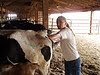
In case you never heard about it: Milk is not really good for you--no reason for grown- ups to drink it. This excellent article claims you should stop. http://www.care2.com/greenliving/skip-milk-5-reasons-why.html:
"Chronic constipation, irritable bowel syndrome, arthritis, chronic sinusitis and allergies" are often "cleared up when they stopped eating dairy."
"In addition to being chemically altered into something that hard to digest and causes problems, today’s milk usually contains steroids, antibiotics, pesticides from treated grains, bacteria from infected animals, and genetically engineered growth hormones."
Sunday, May 23, 2010

Friday, May 21, 2010
Save Hay while the Sun Shineth
Warm summer weather and lots of sunshine are the prerequisite for haymaking, essential fodder for the animals in winter. These days, farms usually make silage, i.e. fermented, high-moisture fodder that can be fed to animals when they can no longer graze outside. Even today, making silage is THE bid social event of the agricultural year where the whole neighborhood gets involved and helps out, doing each farm in turn. The women folks’ job is to cook for the ‘silage men’. Silage is made either by placing cut green vegetation in a silo or by piling it in a large heap covered with plastic sheet, or by wrapping large bales in plastic film.
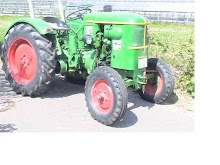
In our first summer, we had allocated only one field and our garden behind the house to making hay. We had opted to save hay the old-fashioned way by hand. Mac used an old scythe for cutting. No lawnmower gives the same result. The blade needed constant sharpening with a honing stone called ‘strickle’. After the grass was cut it had to be raked together in rows which had to be turned every other day. We were lucky, because showers stayed away—otherwise we would have ended up with a useless, indigestible mash. Hence the saying. Then the rows were raked into little heaps, dragon cocks, and then later when the hay had turned crisp and yellow, it was raked into triangle shaped forms called trams. Hay ropes secured the trams from the wind until they were brought into our hay barn. A family bonding experience surely − except when you are allergic to grass like 3 in our family were. One year later, we had a few more acres under hay, and we had them cut by a tractor and made into square bales. Mac loaded the square bales into the jeep and my task was to drive the jeep to the hay barn where a farmhand unloaded and stacked them up. After several trips my hay fever and asthma got the better of me. My nose was the running; I sneezed, accompanied by itching eyes and coughs. Mac’s advice was to take some medication against the unwanted symptoms. I went on strike instead. No more hay transporting in our family car for me. In the following years when he managed the full acreage himself, a contractor did all the work.
In our first summer, we had allocated only one field and our garden behind the house to making hay. We had opted to save hay the old-fashioned way by hand. Mac used an old scythe for cutting. No lawnmower gives the same result. The blade needed constant sharpening with a honing stone called ‘strickle’. After the grass was cut it had to be raked together in rows which had to be turned every other day. We were lucky, because showers stayed away—otherwise we would have ended up with a useless, indigestible mash. Hence the saying. Then the rows were raked into little heaps, dragon cocks, and then later when the hay had turned crisp and yellow, it was raked into triangle shaped forms called trams. Hay ropes secured the trams from the wind until they were brought into our hay barn. A family bonding experience surely − except when you are allergic to grass like 3 in our family were. One year later, we had a few more acres under hay, and we had them cut by a tractor and made into square bales. Mac loaded the square bales into the jeep and my task was to drive the jeep to the hay barn where a farmhand unloaded and stacked them up. After several trips my hay fever and asthma got the better of me. My nose was the running; I sneezed, accompanied by itching eyes and coughs. Mac’s advice was to take some medication against the unwanted symptoms. I went on strike instead. No more hay transporting in our family car for me. In the following years when he managed the full acreage himself, a contractor did all the work.
Thursday, May 13, 2010
A Killer Horse named Scarlett
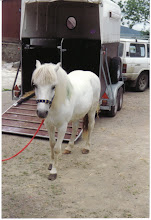
Most little girls like ponies and get into horse-riding. Amy had had riding lessons in Germany before we emigrated and now wished for a pony of her own. The first we got for her was Sparky, but she suffered from laminitis, an inflammation of the hooves often caused by lack of exercise and overeating. She was soon returned and replaced by Rusty who stayed with us till the kids had outgrown a pony that size. To look after a pony entails a lot of responsibilities for a little girl: grooming,riding,feeding and mucking out, in the morning before school and last thing at night. Rusty was housed in one of the outbuildings next to the tack room. She would be prone to that disease as well if you let her feed all day and night in a field of fresh grass.
A keen horseman himself, Mac acquired a 3/4 thoroughbred to go hunting with,a good 15 hands in height, a filly of two years and just broken in. She was quite the primadonna under the horses and had a temperament.
I've always been afraid of horses and their sheer size. On the first day that Scarlett was out in the fields, she frightened the life out of me. It was in new surroundings and appropriately frisky.That was the day we decided to set Benny Bunny free down by the river(See previous blog).I carried him in a box and had both kids,7 and 4, tagging along on either side chatting away. Scarlett circled us for most of the way, coming dangerously close at times. The kids tugged at my arms, frightened, but I couldn't let go of that box. We increased our pace until we made it over the river. There, I reasoned, with out the encumbrance of the box I would be free-- to do what I wasn't sure though. When we stared climbing the hill back up, Scarlett came charging towards us, whinnying and circling us. Her hind legs were precariously close to the heads of my children. Hearts racing, we pressed on and back to the house. Mac appeared at the top of the hill, arms stemmed by his sides: "What's going on?" I shouted: "For God's sakes, grab your killer horse and lead it out of harm's way! It's attacking us!" He shook his head at my ignorance. " Don't you know you just have to shout to shoo them away? That scares them and tells them who is the boss." Hands cupped around his mouth, he yelled a piercing "boo" twice, and Scarlett cantered away, and we to the safety of the gate. After that I preferred to have a stable door between her and me. Both kids, however, overcame their fear and became horsey people, jumping and all.
Friday, April 30, 2010
Which products to buy organic
Just stumbled across this little handy picture guide in an article by Ronnie Citron-Fink on Care2.com. http://www.care2.com/greenliving/organic-revisited-a-free-cheat-sheet-for-buying-organic.html Excellent website for matters organic by the way. While I don't agree with her that the jury is still out whether organic products are healthier, I found this gadget useful. If you have an iphone, you can even download it as an ap.
Saturday, April 24, 2010
Hexane in our organic foods?
As I've done before, current political developments regarding food, environmental, and health issues urge me to take a stand. Being an avid organic fan and promoter I do not want Hexane in my so-called organic veggie burgers. This unsettling piece of information is frightening because of the extent of what food producers do to consumers here in the USA without the requirement of declaring ingredients and production methods. I don't want to spoil your appetite, but the attached links are worth reading and signing the 2 petitions.
The other one concerns a proposed bill which can still be stopped:As written now, the legislation is a big gift to the industrial food producers, and a drastic blow against small farms. Come to the rescue: Unless it is amended, the Food Safety Modernization Act will regulate our local food sources out of business.
Now is the time to come to the rescue of the party. Thanks.
Wednesday, April 21, 2010
Happy Earthday!
Let's enjoy the earth as long as it lasts...silly? With the threats to climate, endangered species and pollution all around us I think it's a realistic danger; if not for our generation, at least for those who come after us after us. I lived an organic, self-sufficient life for about 10 years. As you may have figured out I left that lifestyle and marriage a while ago and lapsed into "normal" buying and living habits.
Now, back to growing my own produce and total awareness of how the earth and our health are connected, I'd like to promote Earth Day: to buy locally and organically. Not only does it help our local economy but also the environment. Instead of hauling i.e. flying produce around the world, take advantage of what is in season and available in a shop near you.
Just this short note today. Amy is here for a visit in the land of plenty that is environmentally challenged. Regarding the insect repellents I wrote about a few weeks back, in her memory not only did we scrape off the slugs from underneath the board in the vegetable garden.We also put them in a jar, ground them up, and sprinkled them between the rows of veggies. So now for you...How could I forget?
No wonder Amy is still traumatized by slugs.
Thursday, April 8, 2010
Benny Bunny
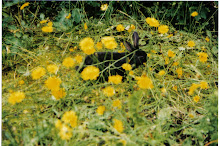
One Saturday morning I drove into Limerick. I had heard they had a fresh market and an organic shop: Green Acres, named after a popular TV show I didn’t know. The actual market was not much to write home about, different to the exquisite fresh and live displays we have in most German towns. I spotted a little black rabbit that I took home as a surprise for my kids.
They were ecstatic and called him Benny Bunny. The same afternoon we built a little timber house for him with an enclosed porch. A lot of sawing and nailing could be heard being done by their father. They helped painting it with creosote to let it withstand the elements. The structure allowed Benny Bunny to nibble at the grass outside his hut while he was safely enclosed by chicken wire. Another plus he couldn’t run away. There was also chicken wire underneath that no critter could dig through. His task was to cut the lawn and the task of my hopeful offspring was to move it a little further everyday and occasionally provide him with a little extra dandelion or something equally scrumptious.
First it was fun, and then they neglected their duties. We had made friends with another German family who were breeding rabbits for meat. That was not our intention, however. Watching my children neglect Benny Bunny for several weeks, I asked them what the problem was. “He shouldn’t be encaged. We like to play with him and he should roam freely.”
“Ok, we are going to set him free and give him his freedom back.” But I didn’t want him too close to my vegetable garden, so I decided to take him beyond the river. From “Watership Down” I seemed to remember that the little fur balls didn’t voluntarily cross a river. I reckoned that would prevent Benny Bunny from coming back and doing damage to the cabbage. We carried him over in a cardboard box and gave him his life back on the other side. On the way back I had my doubts already. Would he make it on his own or be eaten by a fox any time soon? But I kept my thoughts to myself.
Saturday, April 3, 2010
Happy Easter Eggs!
Yesterday it was exactly 20 years that we started our adventure in Ireland. Although in my current chronology of events I’m at a different point in time, I’d like to throw in this typical Easter procedure that was repeated for several years.
Our neighbors’ kids were flummoxed that there was an Easter Bunny to visit German children that brought them sweets and colored eggs—even to those living abroad. In our first year we could see our new neighbors peep through their front windows. It wasn’t customary at the time to have an egg hunt in Ireland. In the following years we invited them to join us but since Mass took precedence, they didn’t often make it.
Since the weather was often dreadful and our offspring couldn’t be relied on to always find what had been left for them, we came up with a clever strategy. On Easter Sunday, Mac would take us through the gardens pretending to look for hidden eggs. He had all the goodies in his big overcoat and dispensed them furtively as he went along. Amy and Patrick hang back with me, thoroughly inspecting each shrub and little tree for possible hiding places. The garden was big enough for him to forge ahead without them noticing. This maneuver had a double benefit. Neither did the chocolates or colored and decorated eggs get soaked nor did we find surprises later in the year when some gardening was going on in that area. We also brought the German tradition of decorating fresh spring twigs with decorated eggs, bunnies or butterflies with us.
Friday, April 2, 2010
Bugs galore
Like death and taxes, there is something utterly certain about organic farming: the arrival of bugs. Together they may impact your joy in organic farming. As the weather will, particularly in Ireland.
Just like the arrival of them here in FL on my bell peppers and even Brussels sprouts within a screen room that’s supposed to keep bugs out. There are a couple of ways dealing with different type of bugs, only few “chemicals” of an organic nature are allowed. I set out to find the one we mostly used in Ireland yesterday: Pyrethrum is the Latin name for chrysanthemums, an ornamental plant. It has been used for hundreds of years as a natural insecticide and a lice remedy. The insect repellent ingredient is taken from dried flower heads.
The best way to deal with bugs is to avoid them in the first place. That can be done at the planning stage of your garden by deliberately choosing which plants to grow together. John Seymour offers a list of solutions in his book, our Bible. To give you a few examples: grow carrots with onions, plant marigold, rhubarb or coriander between vegetables. Their smell deters bugs, allegedly. The main aim is not to grow the same plant in the same spot every year. A change of location, rotating the plants in a four year rhythm is recommended. The creation and improvement of soil is the prime foundation for a productive and healthy garden. This is done through proper techniques of composting and cultivation. Besides, a deep and humus rich top soil produces strong disease resistant plants whose deep roots will survive drought.
Another method is to use ladybirds (ladybugs in America) as natural bug eaters. Alas, they just wouldn’t do it for me. I picked them from one shrub and carried them over to the infested vegetable. They just sat there, lazy, looking bored, and had no idea of what their job was. I see them for sale in a jar here in Florida. Good luck with that method!
I had mentioned planks before that Mac had put between the rows of veggies for convenience of walking, squatting and kneeling while weeding, and also for keeping the weeds down. The downside was that under these planks slugs found a cozy habitat. You simply have to turn over the planks and can pick up the slugs by hand or scrape them off with a tool. Rumor has it that slugs like to drink beer. If you put out little dishes with beer they climb in…and die a nice dead. Ours didn’t comply. Unfortunately the y weren’t of the variety the French like to eat. And I have reconsidered that gourmet option since my farm experience, trust me.
One of the last resorts to get slugs and black bugs out of Brussels spouts was to examine each plant one by one and flick the bugs of by hand or a little knife. A tiring procedure and prone to mistakes. In spite of my best efforts of examining broccoli and cauliflower this way and soaking them in hot salty water for some time, some made it to the plates. My kids have been traumatized this way by finding cooked slugs on their dinner plates. Up to this day many years later, I’m not keen on cleaning fresh Brussels sprouts, peeling off layer after layer of the green overlapping leaves. Not that I’m afraid of finding insects, but it’s a tedious process if you do it conscientiously given my farming background when I buy them organic.
John Seymour further recommends a nicotine solution against bugs or lice: Use 100 cigarette stubs without filter, bring them to the boil with 4 liters of water and let it simmer. Not everybody is a heavy smoker though and I wouldn’t recommend starting it. It’s supposed to work against beetles and caterpillars.
Lime rings prevent an ant infestation on fruit trees. You can keep millipedes from getting in the way if you dig tin can, riddled with holes, into the ground but you must fill it with potato peels. Never tried that since we didn’t have a problem with them. Let me know.
Overall good advice for the protection of your garden: Walls or rabbit fencing should be in place on your boundary. You should have nets, fleece and wire available to protect brassicas, fruit, and peas from birds. You should get keep your garden free of hiding places for slugs. You should encourage beneficial predators such as hedgehogs and frogs. You should make sure there is diversity in your vegetation, including wilderness areas and flowers which harbor beneficial insects and beetles. Hedges will protect your garden from wind and give shelter to beneficial insects over winter.
And don’t forget to swing that hoe regularly between the rows of veggies because the weeds won’t forget to grow in the meantime.
Subscribe to:
Posts (Atom)