One of the frequently asked questions is :How do we know what we buy is really organic?
Your produce is not just organic because a producer says so. There are detailed requirements to be fulfilled in order to qualify for this label. I’m outlining this in detail because I keep encountering skeptics who doubt that organic products are really organic and how do you know that the supermarket is not just putting a label on it in order to raise prices?
If you buy a farm that so far has been farmed conventionally, it takes a few years of “conversion” until you can call yourself organic. Cattle farmers or beef and lamb meat producers like us had to start with letting your fields grow naturally, without the use of artificial fertilizers and pesticides. For that period, your produce is labeled “in conversion” after “an in-conversion license is granted to the successful applicant.” In the meantime the animals you have on your field must be raised without medication and growth promoters.
In Ireland, IOFGA is the official organization that certifies that produce and meat etc. are really organically grown—and that means from start to finish (Irish Organic and Farmers Association).
“The conversion period is the time frame that occurs between applying to IOFGA to convert to organic farming and getting a full organic symbol. In most cases this is two years. When the conversion period is successfully completed a full organic symbol is granted allowing produce to be sold as organic and to display the IOFGA symbol.” (http://iofga.org/certification-and-members/organic-certification/)
An inspector will come to your farm, write an inspection report that then will be examined by the Certification panel.
In Ireland over the past 10 years the organic market has enjoyed high levels of consistent growth. Even in times of economic pressure peoples’ priorities are sourcing food which has been produced with an emphasis on environmental, ethical and health concerns.
Perusing IOFGA’s website, I see you can search growers by product or county. It shows who is in conversion and who is certified. For homework: Note to blogger for homework: check what the American procedure is and compare!
IOFGA now runs classes on how to grow stuff organically (for school projects, hobby growers, allotment holders etc.)
We met lots of likeminded people through attending their meetings because in our neighborhood, nobody else was an organic farmer—yet. We met Jo who was the biggest producer of wheat and procured grain that I ground into flour for baking my breads and cakes; we also made friends with vegetable growers who had been farming organically for some time and had more experience than us. A lot of them were Germans like us or Dutch.
We organics weren’t that many altogether –yet in the early 90s.When my stint on the farm ended, Mac was the second biggest beef producer in the country—and only had 20 animals for slaughter that year.
Monday, March 1, 2010

Friday, February 26, 2010
Raising broilers
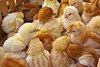
We got our first little chicks (broilers, actually) that summer. I collected 24 of these cute yellow fur balls in a cardboard box from a farmer in our family car. Their chirping and pungent smell --in spite of their miniature size-- quickly filled the jeep. My kids and 2 of the neighbor's ones we had taken with us for the ride where delighted.
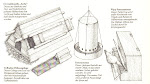
We had built another little hut according to Seymour's specifications. No caged chickens for us! The chicken farms in the neighborhood of my parents home in northern Germany, huge commercial enterprises with thousands of animals that never saw the light of day still make my stomach revolt. It was their stench to be specific. It lay like a smelly blanket over miles of agricultural land and one gave a sigh of relief on leaving that area. Chicken slurry smells just as bad as pig's. That beside the idea of their caged, imprisoned existence put me of eggs and chicken meat for years.
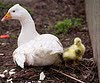
The fur balls turn their color quickly into white when they grow up and develop white feathers.
It posed an immense problem to feed them. The Creamery where we (and other farmers) bought our feeds, only had the usual starter feeds. Enhanced with all the goodies that an organic farmer objects to: grains enhanced with growth promoters to kick start them and medicines for good measure because they normally fall sick early when in confined accommodation. Antibiotics, primarily. We opted for pure maize, unadulterated with any dubious extras, barley and wheat grains all of which we had to crush by hand or an old coffee grinder to make them small enough for the only day-olds.
Every turkey or chicken that you buy that hasn't earned the label organic will have got started on the above mentioned extras. They also fed on grass and the occasional salad leaf, free to roam our garden. They thrived just fine until we slaughtered them for our own consumption when it turned too cold for them.
Our zoo now consisted of 4 lambs, 4 calves, a cat, a dog and 24 broilers as well as a dozen of pullets.
Thursday, February 18, 2010
Conventional vs Organic Meats
Our cattle, lambs, pigs and chickens were grass-fed. They lived a happy life in a natural, healthy environment until they went the way of all flesh. Before we produced our own on the farm, we had practically given up on meats unless it was organic−often hard to get hold of and more expensive.
In contrast to intensive farming, organically raised animals are not confined to tiny cages where they can’t move. They don’t have to live and grow in overcrowded, often filthy and inhumane conditions where they are treated as production units, i.e. they have to put on weight at top speed at lowest costs. They are treated as living creatures instead.
Conventional agriculture pumps animals full of hormones and drugs, feeds them unnatural diets, douses vegetables with chemical pesticides and fertilizers, and introduces genetically modified seeds into the environment. How can the food on your family’s dinner table not be harmful to your health?
Besides the health benefits of organic farming, there is also the environmental result of significantly less fuel consumption, less erosion, less air and water pollution and greater soil fertility.
I can’t eat chicken dishes anymore when eating out unless the menu states specifically grass-fed or free range. If you can’t get organic produce all the time, there is now the “all natural, no-antibiotic, no growth-hormones” raised chicken, pork and beef in some supermarkets here. I have my doubts about this concept, however. Out of my own experience in Ireland, I know that the organic farming status and organic label are hard to achieve and guarantee what they promise.
Friday, February 12, 2010
Thanks for comments
I appreciate comments left. I got the translation of what a Chinese reader wrote: 要持續更新下去喲!!祝你心情愉快 "Please continue updating!! May you have joyful mood."In case anybody else was wondering what it meant...
Sunday, February 7, 2010
Bullocks
When Mac bought 4 calves, I knew he meant business. For self-sufficiency on the farm, even John Seymour said that one cow is enough. It provides you also with your dairy needs including cheese. The four were Aberdeen Angus, a Scottish breed well regarded for its meat and even temper. So down the line, there was a herd planned. Since we didn’t have a milk quota, we couldn’t just produce milk without end. One cow for our personal consumption would have been OK, but we didn’t need more than half a gallon a day for ourselves and neither Mac nor I felt like milking. We didn’t know how to either. But that we could have learned from The Book of course. A cow needs regular milking twice a day. There was a limit, however, to what Mac was willing to do and that didn’t include getting up and milking every morning, or being around late each afternoon. We saw neighbors driving their cattle home along the road each day in the morning and evening messing up the roadway in the process. This was great excitement each time for the dogs steering them; when an impatient car had to follow them patiently until they turned into their familiar yard entrance; or for the farmer’s wife, armed with a stick in wellies and headscarf when it rained. It seemed to be a woman’s job and it seemed to rain a lot. Sometimes children would follow in the back to keep the herd together. Some cows are notorious for sampling what hedgerows have to offer.
We named our new additions to the family Rira, Lulu, Micki and Roisin; two after the characters in Amy’s Irish reader and the other two after my mother and father. Micki‘s purpose in life was to provide us with beef some day. Mac finally explained his intentions that we were starting a herd of suckling cows and that we were into grass and beef — instead of dairy. The calves were already weaned and quickly outgrew our orchard. That’s why we had kept the 4 acres for initially while the rest of the farm was rented out in the first year. Mac had put his economist’s hat on while walking the land one day and a shift change from self-sufficiency to commercial agriculture had occurred by the end of that first year. Our escapist enterprise had to become a viable business.
So we had to learn more about being in the beef business. Cattle come as little bulls and little cows. Bulls must be castrated when less than two months old. For that you don’t need a vet. Elastic bands are fitted around their testicles and they shrivel away over time - some have to be cut then; mercifully, some not - and then they turn into “bullocks.” Easy as pie. Even Nicole Kidman learned to do it for her role in Australia where she plays a British aristocrat of 1930 who get a cattle station as inheritance. For full instructions see How to Castrate a Bull. It keeps bulls' temperments in check -- a wise move unless you are breeding for bulls fights. Nobody in Ireland said steer or oxen. Bullocks — not to be confused with bollocks. It often sounded the same. As did ballcocks, which caused quite a stir lately on an Irish radio show and in ongoing jokes. But that's another story.
Sunday, January 24, 2010
Pullets, chicks and broilers
Triggered off by an inquiry from one of my Followers (!), I’m postponing my compost story (yawn) and also fashion advice for the trendy farmer's woman (shame). We started with about a dozen brown chickens. Laying hens are called pullets. We asked the farmer we bought them from whether they were laying already or not, because it can take up to 6 months until they do -- depending on the breed. Now my dear friend, not knowing how old or what your breed is, I venture to say that, just like girls, chicks start to mature and reach puberty at different times. One of them may well be laying already, as you wrote, whereas the others are still growing and getting ready to produce a life-long supply of your eggs. These pullets, when they are older and past laying, can still be used for nutritious soup. You wouldn’t roast them, because they would be too tough. You want broilers for roasting.
Some hens lay an egg every day, some skip a day. In Ireland, they reduced their production in winter. Even if yours are home in a milder climate, their circadian rhythm may still tell them, "Hey, it’s winter…and the chick union entitles me to have a break.” Keep feeding them as normal with an extra bit of grain or protein. I knew a farmer who swore by fish for that purpose. We always felt the eggs had a fishy smell.
Be careful what you feed them. Most ready-made feeds you can buy consist of undesirable ingredients that we organics don’t approve of: Growth promoters are the worst. Don’t even think about those now just because your hens are not laying yet! More about this topic when we talk about raising 1 day old chicks into juicy roasted chickens. When in doubt, and you can’t buy organic feeds, let them run around free on grass or among vegetable patches and let them scratch and feed where they want, add some grain, grass or unwanted salad leaves. They will not overeat or eat anything that may be bad for them. What you might do to encourage broodiness is putting medium sized plastic buckets with straw inside into the hen house. They have their individual little cubbyhole which they adopt and where they lay their eggs. Nothing worse than trying to find eggs in the hedgerows every morning if you have free ranging hens!
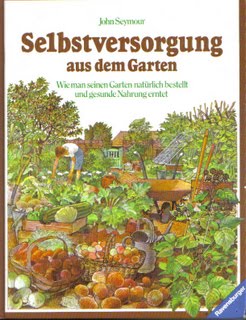
Make sure the chicken house is safe. We followed John Seymour’s ARK type. It has to be above ground so that badgers and rats or foxes don’t dig through. Otherwise a tight chicken mesh is advisable. Tall enough for easy access with a lockable door. A roof also helps against intruders from above, even big dogs jumping in and having a field day; a fence around their designated area is advisable but not fox proof. Lock the hen house at dusk. That’s when Mr. Fox strikes. Open up late mid morning after they have laid their egg -- probably. Don’t count you eggs before they are laid:}
I sold our surplus eggs at the local news agent. Which was against EU regulations. (Oops!). Eggs have to be officially screened against diseases. So Liam kept them under the counter and customers discreetly asked for them. Everybody loved our fresh eggs and got upset in winter when the demand was higher than the hens’ productivity.
Sunday, January 17, 2010
What you Need to Know about GM Foods
In the USA most children think milk comes from the supermarket and peaches from a can, according a recent survey; even the kids in Georgia where most peaches are grown. That shows how far removed from the sources of our food we’ve become. Kids never set foot on a farm.
By the same token, most people think the food in the frozen food isle is actually real food, not realizing it's chock full of unnatural additives; preservatives, colorings, and artificial flavorings. That was one of the reasons we chose to grow our own food/produce 20 years ago. We felt that returning to natural eating habits was a must. Even more so today.
And Healthy Eating Starts with NO GMO! The problem here in the States is that genetically modified produce need not be labeled. So you don’t know what you are eating. You can assume, however, that you take in 70% genetically modified foods if you live off the fast food isle. I highly recommend reading Jeffrey Smith’s books, Seeds of Deception and Genetic Roulette. Jeffrey Smith
Smith documents at least 65 serious health risks from GM products of all kinds, including,and I quote:
“Male mice fed GM soy have damaged young sperm cells
The embryo offspring of GM soy-fed mice have altered DNA functioning
Several US farmers have reported sterility or fertility problems among pigs etc.” The list goes on and on. To sum it up: GMO foods can be: • Allergenic • Toxic • Carcinogenic • Anti-nutritional".
How can we avoid GM food? By buying organic. I experienced firsthand how difficult it is to acquire that well-earned label “Organic”. Get this quintessential shopping guide that lists GM foods: http://www.nongmoshoppingguide.com/SG/Home/index.cfm.
Dr. Mae-Wan Ho of the Institute of Science in Society (ISIS) explains the heart of why GM foods are so dangerous: Playing with Technology We Don’t Fully Comprehend (read the full article on Mercola Article on GM.
Products to avoid that contain these at-risk ingredients are 1. Soy 2. Corn 3. Cotton 4. Canola. I don’t know how cotton gets into the food chain, but soy and canola oil is prevalent here and hard to circumnavigate.
Germany – together with 5 other countries in the EU- has banned growing GM corn. And their food products need to be labeled.
The American Academy of Environmental Medicine has called for a moratorium on genetically modified foods! Genetically modified foods That’s food for thought, ain’t it?
Sunday, January 10, 2010
Nixers, gurriers and eejits
Instead of explaining how to start a compost heap, my mind segues to some more typical, if idiosyncratic Irish expressions. After the “tirty-tree” nothing much surprised me. Just as well the Irish don’t go for putting suffixes after the names of their offspring much like here in the US, e.g. Jim Mahoney, III…
My piano teacher called Mozart a gas man. I had no idea what she was talking about: funny, hilarious, of course. Here in the US ‘gassy’ has entirely different connotations. In other words, Mozart was a character. A character is not just any character but a unique, rare, one of a kind individual. It doesn’t imply he isn’t the full shilling. But politeness mostly prevails and a mentally challenged person is just “innocent, God love him!”
Your ‘gaff’ is simply your abode. If his place was a ‘kip’, stay away (a dump). No gurriers in my neighborhood please! Kipping, however, is normal and allowed (napping).
Snogging is prevalent and also used in the UK, but unheard of in the US. Don’t overdo or you’ll feel knackered or banjaxed.
A blow-in could be somebody who moved in from far away like us, or just from across the other side of the bridge, as was the case in our town. There the bridge was the border between Co. Tipperary and Co. Clare.
One of the old diehards when a baby is born: “Is it a boy or is it a child?”
A well-endowed, top-heavy woman “has all on it”.
A Brit will understand what a woolly jumper is or a trolley. Nixing is a bit of work on the side, and not necessarily known to the taxman.
To call a person or something previous when they mean premature leads us in the area of malapropisms. Pity I loaned my priceless book on that topic to a friend and never got it back. It’s out of print, unfortunately. My housekeeper kept all her referees in a box under the bed.
It’s easy to go mental with all these exotic expressions, isn’t it? My all time favorite is the ‘eejit’. Met a few in my life. In contrast to idiot, it’s a term of endearment. Alas, not everybody outside Ireland understands that and may take offence. So now for you. There you have it in a nutshell.
I am skipping true slang phrases here. There is a book with more of these expressions if this whetted your appetite: The Feckin’ Book of Everything Irish. (The effing word is acceptable as long the vowel is changed).
I could go on and on…Let me finish with two quotes:
“This is one race of people for whom psychoanalysis is of no use whatsoever.” (Sigmund Freud about the Irish). Don’t you just love the Irish?
And: “Ask me no questions, and I’ll tell you no lies.” Oliver Goldsmith (1728-1774)
Next week I'll start the compost heap; promised!
Saturday, January 2, 2010
1030 Trees
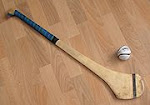
When we bought the farm we had 1000 trees planted down by the river, a mixture of firs and deciduous trees. Mac had the idea we could always sell them as firewood and that could be an extra income in years to come. Alternatively, the ash could be used for making hurling and camogie sticks. They were down by the river, a good bit away from the house. Since we didn’t live on the farm then permanently, we couldn’t look after them in the first year after planting when there is the danger of the little saplings being overgrown by weeds. Herbicides and any non- organic spray were out of the question anyway. We hired a farmhand, Siney, to trample the weeds instead and paid him all summer long. While we were there on vacation we helped, Mac and I, and to some extend the two toddlers who grew tired of this pastime even faster than I did. Whenever we checked on Siney, he was just having a tea break or asleep in the high grass. Did he even turn up in our absence, I wondered?
On the yard and in the front garden, we planted 10 edible chestnut and walnut trees, fully aware that it would take 10 years for them to produce the first nuts. Ironically, the first nuts showed up the year I left the farm.
Our orchard had a dozen or so of old apple trees which didn’t bear much fruit anymore and they were tiny. Maybe older trees aren’t that prolific anymore anyway, or the lichen that grew on their stems prohibited their growth. The summer I was pregnant with Patrick, before we moved in for good, we tackled the lichen. A triangular gadget with 3 sharp edges, a scraper, was used to scrape off the unwanted growth on the bark of the trees. Not exactly how a 6-months pregnant woman wants to spend her vacation but it had to be done. Later we planted an additional orchard of about 20 apple trees where we erected a big greenhouse in the field near our vegetable rows. Young apple trees need about four years to mature. Especially in the first year, their stems need to be grass free. Mulching is a good method to keep the weeds down. We put paper down around them with grass cuttings on top.Obviously we couldn’t do that with the 1000 trees.
Apple trees want proper cutting; preferably in the winter to keep them in shape. A summer cut needs to check that year’s growth. A tree that is pruned doesn’t produce any fruit but puts all its energy into growing. A good bit of manure as fertilizer will prepare their growth for the coming year. In spite of good care taking we never had enough apples for our apple juice and cider making needs. But more about that another time.
Subscribe to:
Posts (Atom)